

WATCHES / CULTURE / PORTLAND
The Tom Peterson Watch
The Strange Portland Timepiece That Found Its Way Onto Kurt Cobain’s Wrist
A cheap Portland promotional watch became an unlikely piece of rock history
There is nothing about the Tom Peterson watch that should make it collectible.
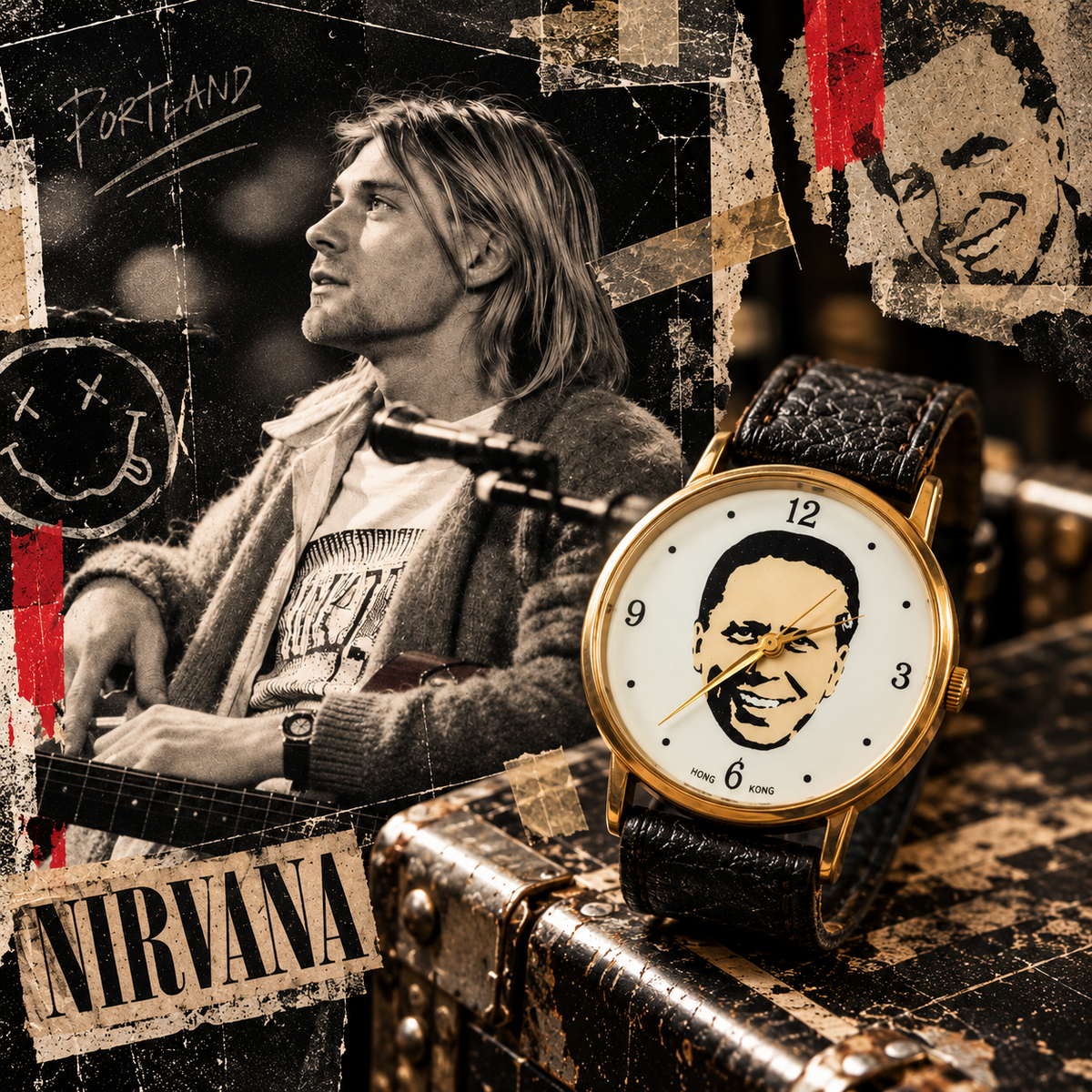
It is a small, inexpensive quartz promotional watch manufactured in Hong Kong, with a black plastic case, a simple black strap and the smiling face of a Portland furniture and appliance salesman printed across the dial. It wasn't made by a historic watch manufacture. There is no interesting mechanical movement inside it, no precious metal and no great feat of watchmaking to discuss.
It was advertising.
And yet, more than three decades later, the Tom Peterson watch has become one of the more fascinating pieces of Pacific Northwest watch ephemera I have encountered. It sits at the intersection of Portland history, 1980s local television, American retail culture and, unexpectedly, Kurt Cobain.
I recently bought one.
The more I learned about the watch, the more I realized that its story is much bigger than the strange little object sitting in front of me.
The Man on the Dial

For someone who didn't live in Portland during Tom Peterson's heyday, it is difficult to appreciate just how recognizable he was.
Peterson wasn't a celebrity who happened to own a business. The business made him a celebrity.
Before Portland, Peterson had spent roughly a decade working for Green Giant. According to his family, a chance encounter with a Muntz television executive eventually led him west. Peterson sold his home, moved his family to Oregon and opened Tom Peterson's Discount Centers in Portland in 1964. His first store was at Southeast 82nd Avenue and Foster Road.
The business grew quickly. First-year revenue was reportedly around $300,000. By 1989, Tom Peterson's was doing approximately $30 million in annual sales. Along the way, Peterson became nearly inseparable from Portland television.
His advertising was deliberately unsophisticated and relentlessly memorable. Beginning in the 1970s, Portland television viewers encountered his late-night "Wake up! Wake up!" commercials. Peterson would appear to knock on the television screen and command viewers to wake up and come shopping. His stores stayed open extraordinarily late, at times until 3 a.m., giving the commercials an almost surreal logic of their own. Another Peterson phrase, "Free is a very good price," became part of the local vocabulary.
He also understood something about branding decades before anyone started talking about personal brands.
Tom Peterson sold Tom Peterson.
His unmistakable flattop and smiling face appeared everywhere. There were T-shirts, mugs, coloring books, Halloween masks, alarm clocks and free haircuts styled like Tom's own flattop. His obituary even recalled promotions involving free poodles. Peterson's face became so familiar around Portland that local stencil artists appropriated it for "Trust Tom" graffiti.
Then there were the watches.
A Furniture Store Giveaway Becomes a Cult Watch


The Tom Peterson wristwatch was exactly what it appeared to be: a promotional product designed to keep a retailer's face in front of customers.
The dial was dominated by Peterson's portrait. A small rhinestone marked 12 o'clock. Inside was a basic quartz movement. The surviving example later attributed to Kurt Cobain was described as Hong Kong-made. Nothing about the construction suggested that anyone expected people to be discussing these watches decades later.
But people actually wanted them.
Peterson himself considered the wristwatch one of his most successful promotions. In 1988, he commented on the watch's unexpected popularity among college students, calling it something of a "cult thing."
That detail changes how I look at the watch.
It wasn't merely an appliance-store giveaway that later became interesting because Kurt Cobain happened to wear one. The watch had already developed its own ironic cultural life in the Pacific Northwest. Young people were wearing the face of a middle-aged furniture salesman on their wrists because there was something funny, local and decidedly uncool about it.
And in the late 1980s and early 1990s, deliberately uncool could be very cool.
That brings us to Kurt Cobain.
The Watch on Kurt Cobain's Wrist


At some point, a Tom Peterson watch found its way onto Cobain's wrist.
Exactly how he got it is less clear.
What is well documented is that he wore it, and apparently wore it often.
The watch appears in photographs of Cobain and was worn during an extraordinary period in Nirvana's history. When an example represented as Cobain's personal watch was offered by Heritage Auctions in 2008, the auction house identified it as the watch seen during the 1993 MTV Unplugged period, in the "Heart-Shaped Box" music video, in Nirvana press photographs and in candid photographs of Cobain.
According to Kat Bjelland, singer and guitarist of Babes in Toyland and a longtime friend of Cobain, it was the only watch he wore. Her account formed an important part of the watch's provenance when it appeared at auction.
That makes the choice fascinating.
By 1993, Nirvana was one of the biggest bands in the world. Nevermind had transformed the group from a Pacific Northwest band into an international phenomenon. Cobain could have worn virtually any watch he wanted.
Instead, there was Tom Peterson smiling from his wrist.
There is a temptation to assign some profound meaning to that choice, but I think doing so would miss what makes the object interesting. I have found no reliable account from Cobain explaining why he wore it. There doesn't need to be one.
Cobain's public image was famously resistant to the polished machinery of celebrity culture. Against that backdrop, a cheap promotional watch bearing the face of a local furniture salesman feels strangely appropriate. Whether the choice was ironic, affectionate, regional, accidental or simply because he liked the watch is something we may never know.
The object speaks pretty well for itself.
The Watch After Cobain

The history becomes more somber after Cobain's death on April 5, 1994.
According to the provenance supplied to Heritage Auctions, Courtney Love gave Cobain's Tom Peterson watch to Kat Bjelland within days of his funeral as a memento of her friend. Bjelland later said that the watch stopped running approximately one week after Cobain's death and that she intentionally left it unrepaired.
The watch eventually surfaced publicly through Heritage Auctions in October 2008. It was accompanied by a notarized letter from Bjelland. By then it showed exactly the sort of wear one would expect from an inexpensive watch that had actually been used. Part of the strap was missing, oxidation was visible on the caseback, and the little rhinestone that had once occupied the 12 o'clock position had come loose and was floating inside the dial. The lot did not sell at that auction.
There is an interesting problem with the auction description itself. Heritage incorrectly described Tom Peterson as a "Seattle-area car dealer" and suggested that only a handful of the watches had been produced. The historical record tells a different story. Peterson was a Portland furniture, appliance and electronics retailer, and hundreds of his watches were still around when his original company went through bankruptcy.
That mistake has apparently been repeated in parts of the watch world ever since.
The real history is actually better.
The Watch That Helped Tom Peterson Come Back

By the beginning of the 1990s, Peterson's retail empire was in trouble.
In 1989, he acquired the struggling Stereo Super Stores operation, reportedly paying $940,000 plus another $1 million for inventory. The expansion proved disastrous. In October 1991, Tom Peterson's filed for Chapter 11 bankruptcy protection with approximately $7.5 million in liabilities against $2.7 million in assets. Peterson later joked that Stereo Super Stores should have been called "Stereo Stupid Stores."
The stores eventually closed in March 1992.
Then came one of my favorite details in the entire Tom Peterson story.
Peterson's son-in-law, Robert Condon, reportedly purchased hundreds of Tom Peterson wristwatches and alarm clocks from the bankruptcy trustee. He resold the memorabilia at a profit, and the money became part of the seed capital used to restart the family business.
In September 1992, Tom returned to the original area at 82nd and Foster with an 11,000-square-foot showroom and a new name:
Tom Peterson & Gloria's Too!
The addition of Gloria Peterson to the name was fitting. She had warned Tom against the Stereo Super Stores acquisition in the first place. When the business returned, Gloria was back as chief financial officer, their daughter Kathy handled accounting, and Condon served as president. Tom, naturally, remained the face of the operation.
So these goofy little watches did something remarkable twice.
One ended up on the wrist of Kurt Cobain.
Hundreds of others helped finance Tom Peterson's comeback.
That is considerably more history than anyone expects from a plastic quartz watch with a furniture salesman printed on the dial.
What Makes a Watch Worth Collecting?

As a watch collector and now a watch designer, I spend a lot of time thinking about why certain watches matter.
The traditional answers are easy. Craftsmanship matters. Movement architecture matters. Rarity matters. Design matters. Provenance matters. The name on the dial certainly matters to the market.
But watches also absorb history.
That's harder to quantify.
A technically extraordinary watch can spend its entire existence sealed in a safe and have virtually no story at all. Meanwhile, an inexpensive quartz watch given away by a Portland retailer can somehow connect a furniture salesman, late-night television, a spectacular business failure, a family comeback and one of the defining musicians of the 1990s.
That is why I wanted one.
My Tom Peterson watch has no connection to Kurt Cobain himself. It is simply another surviving example of the same promotional watch. I think that distinction matters, particularly in a collecting world where a good story has a habit of becoming "provenance" after being repeated enough times.
But I don't need mine to have belonged to anyone famous.
The watch itself is the artifact.
Tom Peterson's business ultimately closed for good in February 2009. Peterson died in 2016 at age 86 after battling Parkinson's disease. By then, the television landscape that had made local personalities like him famous had largely disappeared. The idea that a local furniture salesman could become so culturally ubiquitous that college students wore his face on their wrists now seems almost impossible.
Yet the watches remain.
Every once in a while, one emerges from a drawer, an estate sale or an online auction. Usually the little black case is scratched. The strap may be deteriorating. The movement may or may not work. Tom is still there on the dial, smiling beneath that immaculate flattop.
To most people, it probably looks like junk.
To a Portlander of a certain age, it is nostalgia.
To a Nirvana collector, it is connected to Kurt Cobain.
To a watch collector, it is an oddity.
To me, it represents something I think the watch industry occasionally forgets: a watch does not have to be expensive to be important.
Sometimes the value isn't inside the case.
Sometimes it's the story the watch managed to collect along the way.
And few watches have collected a stranger story than the Tom Peterson watch.
Davis Raine
Founder, Wayward Watch Company
Find Your Way.
